Clinical Evidence Review
Do Renal Benefits with Sacubitril/Valsartan in HF Depend on the Kidney Endpoint Used?
Posted on 3 July 2026 7 mins read

This content is intended for healthcare professionals as clinical decision-support education. It supports, but does not replace, independent clinical judgement.
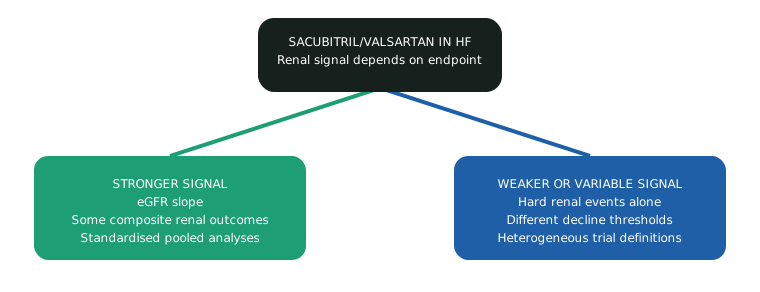
A new meta-analysis suggests the apparent renal benefit of sacubitril/valsartan in heart failure (HF) is not a simple yes-or-no finding. The signal appears to strengthen or fade depending on whether trials use estimated glomerular filtration rate (eGFR) slope, sustained eGFR decline, end-stage kidney disease, or broader composite kidney outcomes, making endpoint choice central to bedside interpretation in patients with concurrent chronic kidney disease (CKD).
Why Endpoint Interpretation Matters in HF and CKD
In HF with CKD, renal follow-up is rarely a purely nephrological exercise. Small early creatinine rises may reflect haemodynamic change during neurohormonal blockade or decongestion rather than structural injury, while a longer-term slowing in eGFR decline may coexist with short-term laboratory fluctuation. That distinction matters because sacubitril/valsartan already sits within guideline-directed HF therapy in the Malaysian Ministry of Health heart failure guideline, yet specialists still have to decide how much weight to give transient renal change versus hard cardiovascular benefit in individual follow-up.
The current literature does not support a uniform statement that sacubitril/valsartan is either renoprotective or renally neutral in all contexts. Instead, across meta-analyses and pooled trial datasets, the answer depends materially on which kidney outcome is counted, how that outcome is defined, and which HF phenotype is included. This is particularly relevant in shared cardio-renal practice, where serial monitoring capacity may vary between tertiary services and shared-care settings.
How the Updated Evidence Fits Together
Jara-Palomares and colleagues, in an updated meta-analysis focused on hard renal outcomes in HF with and without CKD, argue that endpoint definition is a decisive source of variation in reported benefit. That framing is reinforced, rather than contradicted, by the 2025 systematic review and meta-analysis by Barboza and colleagues, which found favourable effects of sacubitril/valsartan on renal function outcomes in adults with HF versus angiotensin-converting enzyme inhibitor (ACE inhibitor) or angiotensin receptor blocker comparators, while still acknowledging heterogeneity in trial design and outcome selection.
The participant-level analysis by Mc Causland and colleagues sharpens the methodological point further. Across six randomised clinical trials, standardised kidney outcomes were infrequent, and the apparent treatment signal was sensitive to the threshold chosen for decline. In practical terms, that helps explain why older trial-level discussions sometimes looked inconsistent: investigators were not always counting the same biological story in the same way.
Evidence Callout
Standardised Kidney Outcomes
6
Randomised clinical trials harmonised in the participant-level renal analysis.
Variable
Outcome signal when threshold choice and endpoint construction differ across datasets.
Evidence synthesis also indicates that the renal story should not be isolated from overall HF benefit. Post hoc data from PARADIGM-HF and PARAGON-HF suggest that even when eGFR deteriorates to below 30 mL/min/1.73 m² during follow-up, ongoing sacubitril/valsartan may still preserve cardiovascular advantage versus renin-angiotensin system inhibition, supporting careful continuation rather than reflex withdrawal when no alternative toxicity signal is present.
Which Renal Measures Are Actually Informative?
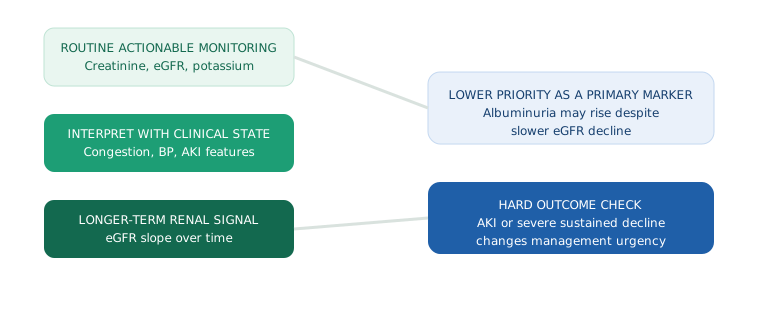
For bedside monitoring, the most useful renal metrics are serial serum creatinine, eGFR change from baseline, serum potassium, and overt acute kidney injury (AKI) or worsening renal function events. Evidence synthesis indicates that these measures best guide decisions to continue, reduce, withhold, or investigate therapy because they directly capture tolerability and immediate safety.
By contrast, eGFR slope is the stronger medium-term research and specialist follow-up marker for renal preservation, but it is less useful as an early trigger in routine clinic because it requires repeated values over time. Albuminuria is even more problematic as a primary response marker in HF treated with sacubitril/valsartan. Across the current literature, albumin excretion may increase modestly even while eGFR decline slows and cardiovascular outcomes improve, so an isolated rise in urinary albumin should not be overread as treatment failure.
| Renal Metric | Main Clinical Use | Interpretive Limitation |
|---|---|---|
| Creatinine or percentage eGFR change | Early tolerance after initiation or uptitration | May reflect haemodynamic change rather than injury |
| Serum potassium | Highest immediate biochemical safety value | Affected by concurrent mineralocorticoid receptor antagonist therapy and CKD severity |
| eGFR slope | Best longitudinal renal preservation marker | Less practical for rapid bedside decisions |
| Albuminuria | Contextual phenotyping in proteinuric CKD | Can move discordantly with overall renal benefit |
| AKI events or hard renal outcomes | Meaningful adverse endpoints in trials and practice | Often too infrequent to fully characterise treatment trajectory |
Mechanism, Phenotype, and Why Bedside Strategy Still Has to Be Individualised
The biological plausibility for divergent renal endpoints is straightforward. Sacubitril/valsartan operates within a cardiorenal system in which neurohormonal modulation, intraglomerular haemodynamics, congestion relief, diuretic exposure, blood pressure reserve, and potassium handling all influence what a renal laboratory change means. A modest early eGFR dip may therefore be compatible with longer-term benefit, while active AKI, marked hypotension, or uncontrolled hyperkalaemia should trigger a different response.
Evidence synthesis indicates that sequencing in CKD-prone HF is best driven by the dominant constraint rather than by a rigid one-drug-at-a-time model. When hypotension or renal volatility predominates, sodium-glucose cotransporter-2 (SGLT2) inhibitors and careful loop diuretic adjustment may be easier early steps, with sacubitril/valsartan introduced at low dose once volume status and blood pressure are interpretable. When hyperkalaemia risk dominates, sacubitril/valsartan may remain feasible, but mineralocorticoid receptor antagonist (MRA) therapy is often the more potassium-limited pillar.
At the bedside, this reframes the renal question. The issue is not simply whether sacubitril/valsartan protects kidneys, but which patient phenotype is being treated, which comparator is relevant, and which renal endpoint is sufficiently sensitive, frequent, and clinically meaningful to justify a change in therapy.
- ACE:
- angiotensin-converting enzyme ;
- AKI:
- acute kidney injury ;
- ARNI:
- angiotensin receptor-neprilysin inhibitor ;
- BP:
- blood pressure ;
- CKD:
- chronic kidney disease ;
- eGFR:
- estimated glomerular filtration rate ;
- ESKD:
- end-stage kidney disease ;
- HF:
- heart failure ;
- MRA:
- mineralocorticoid receptor antagonist ;
- RAAS:
- renin-angiotensin-aldosterone system ;
- SGLT2:
- sodium-glucose cotransporter-2