Clinical and Market Trends
Will New Sacubitril-Valsartan and Dapagliflozin Registrations Move HF Optimization Earlier in Outpatient Care?
Posted on 3 July 2026 8 mins read

This content is intended for healthcare professionals as clinical decision-support education. It supports, but does not replace, independent clinical judgement.
New Philippine registrations for heart failure (HF) therapies, specifically sacubitril-valsartan and dapagliflozin, sharpen a practical question for specialists: whether broader product availability can finally shorten the time to guideline-directed medical therapy (GDMT) optimization in clinic. The evidence base already supports earlier multidrug initiation, but outpatient pacing still depends on blood pressure, renal function, potassium, congestion status, and the capacity to monitor patients closely.
Why Earlier Outpatient Optimization Is Now the Main Question
The current heart failure treatment debate is no longer whether sacubitril-valsartan and sodium-glucose cotransporter-2 (SGLT2) inhibition belong in modern care. The 2022 American Heart Association, American College of Cardiology, and Heart Failure Society of America guideline places both angiotensin receptor-neprilysin inhibitor (ARNI) therapy and SGLT2 inhibition within contemporary heart failure management, reinforcing a move away from slow linear escalation toward earlier use of multiple disease-modifying classes.
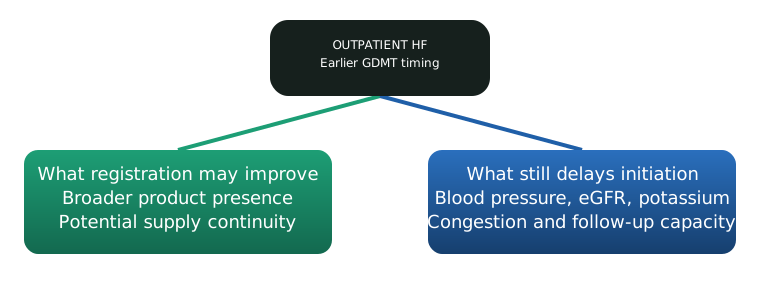
For outpatient specialists, the practical significance of new Philippine FDA registrations is therefore not evidentiary but operational. If continuity of supply improves, the implementation bottleneck may shift from nominal availability to clinic measurement: whether the patient is euvolemic, whether systolic blood pressure is adequate for vasodilator therapy, whether estimated glomerular filtration rate (eGFR) permits dapagliflozin initiation, and whether laboratory follow-up can be done soon after treatment changes.
How the Evidence Base Supports Early Sequencing, but Not Uniform Timing
Dapagliflozin has the clearest phenotype-spanning evidence in the supplied sources. In DELIVER, dapagliflozin reduced the composite of worsening heart failure or cardiovascular death in patients with mildly reduced or preserved ejection fraction, extending the case for early SGLT2 inhibition beyond heart failure with reduced ejection fraction (HFrEF). A combination analysis from the same program reported benefit even among patients already receiving a mineralocorticoid receptor antagonist (MRA) or sacubitril-valsartan, supporting an additive rather than substitutive approach to sequencing.
Across the current literature, evidence synthesis also indicates that in stable ambulatory HFrEF, clinicians should aim to establish all four foundational therapies early, specifically ARNI therapy or other renin-angiotensin system blockade, an evidence-based beta-blocker, an MRA, and an SGLT2 inhibitor, with sequencing tailored to hemodynamics and renal function rather than historical stepwise order. This is concordant with the 2022 guideline framework, although the Dx synthesis contributes the practical sequencing language rather than a page-specific AHA/ACC/HFSA directive.
The supplied contexts do not include primary PARADIGM-HF, DAPA-HF, or PARAGON-HF publication metadata. Because those trials are not directly provided as source publications here, their headline results should not be restated as standalone facts. What can be stated from the available evidence is that current guidance and synthesis support sacubitril-valsartan as early foundational therapy in eligible HFrEF patients, and dapagliflozin as an early, broadly applicable option, including when blood pressure is borderline.
Trial callout
DELIVER
Benefit
Dapagliflozin improved the composite of worsening HF or cardiovascular death in mildly reduced or preserved ejection fraction.
Additive
Benefit was retained in analyses of background MRA or sacubitril-valsartan use.
Assessing the outcome
In ambulatory care, timing depends less on diagnostic labeling than on repeatable clinic variables. For dapagliflozin, evidence synthesis indicates a practical initiation threshold of eGFR at least 25 mL/min/1.73 m², absence of active volume depletion, and hemodynamic stability. A small early dip in eGFR may occur after initiation and is usually not, by itself, a reason to stop therapy if the patient remains clinically stable.
Potassium is not a dapagliflozin-specific gatekeeper, but baseline and follow-up potassium still matter because heart failure patients are frequently receiving angiotensin-converting enzyme inhibitor (ACE inhibitor), angiotensin receptor blocker (ARB), ARNI, or MRA therapy at the same visit. Across the current literature, potassium above 5.0 mmol/L functions more as a warning signal for the broader guideline-directed medical therapy stack than as a direct contraindication to dapagliflozin itself.
For sacubitril-valsartan, apparent intolerance early in optimization is often a misclassification. Evidence synthesis indicates that asymptomatic low blood pressure, or a mild and non-progressive creatinine or eGFR change soon after initiation, should usually prompt reassessment of volume status, concurrent vasodilators, loop diuretic burden, and nonsteroidal anti-inflammatory drug exposure rather than immediate withdrawal. NICE thresholds cited within that synthesis recommend baseline renal function and electrolytes, repeat testing 1–2 weeks after initiation and 1–2 weeks after each dose increase, and local action if serum creatinine rises by more than 50% or potassium exceeds 5.5 mmol/L.
| Variable | Supports Starting | Supports Delay or Recheck |
|---|---|---|
| eGFR for dapagliflozin | At least 25 mL/min/1.73 m² | Below 25 mL/min/1.73 m² for new initiation |
| Volume status | Euvolemic, no symptomatic hypotension | Hypovolemia, overdiuresis, poor intake, active acute kidney injury |
| Potassium | Acceptable for the broader GDMT regimen | More concern when above 5.0 mmol/L for overall regimen, and escalation if above 5.5 mmol/L in the NICE-based sacubitril-valsartan framework |
| Blood pressure | Clinically adequate perfusion, no shock or syncope | Persistent symptomatic hypotension or hypoperfusion |
Why Sacubitril-Valsartan and Dapagliflozin Are Best Viewed as Complementary
The therapeutic logic for early combination is mechanistic as well as empirical. The 2022 AHA/ACC/HFSA guideline positions therapies with different biologic targets within the same contemporary framework for heart failure care. Within the supplied evidence synthesis, dapagliflozin is favored early in many ambulatory patients because it is simple to start, requires no titration, and usually exerts little immediate blood pressure effect. Sacubitril-valsartan, by contrast, is also foundational but more likely to be paced by blood pressure tolerance and renal reassessment.
That difference in early tolerability explains why sequencing should be individualized without reverting to outdated serial monotherapy logic. In borderline blood pressure, evidence synthesis indicates that dapagliflozin and an MRA are often the easiest early additions, with low-dose beta-blocker or low-dose sacubitril-valsartan layered next according to pulse, congestion, and symptom trajectory. If switching from an ACE inhibitor to sacubitril-valsartan, a washout of at least 36 hours remains the specific evidence-based safety interval cited in the synthesis.

What Changes for Medication Strategy in Clinic
The most defensible implementation message is not that new registrations alter the evidence hierarchy, but that they may allow specialists to act on the existing hierarchy with less delay. In stable ambulatory HFrEF, sacubitril-valsartan should generally be started early as part of foundational therapy, rather than only after full beta-blocker, MRA, or dapagliflozin establishment. Dapagliflozin can also be started early, usually at 10 mg once daily, provided eGFR is at least 25 mL/min/1.73 m² and the patient is not hypovolemic.
What still matters is pacing. Specialists should distinguish true sacubitril-valsartan intolerance from transient adaptation during early GDMT optimization. Continuation is generally preferred when blood pressure is low but asymptomatic, or when renal changes are mild and non-progressive. Dose reduction becomes more reasonable when symptomatic hypotension persists, or when renal deterioration remains nontrivial after correcting reversible contributors. Holding or stopping is more appropriate for syncope, shock, progressive acute kidney injury, marked hyperkalemia, or suspected angioedema.
Across the current literature, this means that if wider local supply truly improves, the most relevant performance metrics may be time from diagnosis to first disease-modifying prescription, time to low-dose quadruple therapy, interval to first laboratory reassessment, and the proportion of apparent ARNI intolerance cases that resolve after volume and concomitant-drug review rather than discontinuation.
- ACE:
- angiotensin-converting enzyme ;
- ARB:
- angiotensin receptor blocker ;
- ARNI:
- angiotensin receptor-neprilysin inhibitor ;
- AHA:
- American Heart Association ;
- ACC:
- American College of Cardiology ;
- eGFR:
- estimated glomerular filtration rate ;
- GDMT:
- guideline-directed medical therapy ;
- HF:
- heart failure ;
- HFpEF:
- heart failure with preserved ejection fraction ;
- HFrEF:
- heart failure with reduced ejection fraction ;
- HFSA:
- Heart Failure Society of America ;
- MRA:
- mineralocorticoid receptor antagonist ;
- NICE:
- National Institute for Health and Care Excellence ;
- RAAS:
- renin-angiotensin-aldosterone system ;
- SGLT2:
- sodium-glucose cotransporter-2