Clinical Case Study
Prescription-Only Domperidone in an Older Adult with Heart Failure and CKD: A Cardiac Risk Review Case Study
Posted on 3 July 2026 7 mins read

This content is intended for healthcare professionals as clinical decision-support education. It supports, but does not replace, independent clinical judgement.
After domperidone became prescription-only in the Philippines, an older adult with heart failure (HF), chronic kidney disease (CKD), and polypharmacy presents a common prescribing checkpoint. Across the current literature, the practical question is not whether domperidone has a cardiovascular signal, but whether baseline risk, medication interactions, and dose-duration limits make repeat exposure unjustified.
Summary and Introduction
The Philippine Food and Drug Administration (Philippine FDA) has formally classified domperidone as a prescription-only medicine rather than an over-the-counter product, creating a useful safety checkpoint for clinicians who encounter recurrent nausea in older adults with multimorbidity. That shift matters particularly in cardiology-facing practice because observational evidence has consistently linked current domperidone use with higher odds of ventricular arrhythmia and sudden cardiac death, even though randomized efficacy trials are not designed to resolve rare arrhythmic outcomes. Two peer-indexed meta-analyses reported broadly similar pooled risk signals, around 1.6 to 1.7 for ventricular arrhythmia or sudden cardiac death, supporting a persistent concern rather than an isolated database finding.
Evidence synthesis also indicates that risk becomes more clinically actionable in adults older than 60 years, at doses above 30 mg daily, and in the presence of structural heart disease, heart failure, bradycardia, electrolyte disturbance, or co-prescribed corrected QT interval (QT)-prolonging or cytochrome P450 3A4 (CYP3A4)-inhibiting drugs. The case below illustrates how prescription-only status should trigger medication reconciliation rather than automatic continuation of a familiar symptom medicine.
Patient Case Presentation
A Filipino woman in her early 70s was reviewed after two days of postprandial nausea without chest pain, syncope, hematemesis, or focal neurologic symptoms. Her background included chronic heart failure (HF), chronic kidney disease (CKD), hypertension, and type 2 diabetes mellitus. She had previously received intermittent domperidone from community sources before the current prescription-only policy shift. Her regular medicines included loop diuretic therapy and several chronic cardiovascular agents, raising immediate concern for electrolyte instability and polypharmacy-related interaction burden.
On review, the immediate prescribing question was whether short-course domperidone remained reasonable. The main risk modifiers were her age, underlying cardiac disease, CKD, likely exposure to diuretic-associated biochemical shifts, and the possibility of unrecognized co-prescribed QT-prolonging or CYP3A4-inhibiting drugs across fragmented care settings.
Differential Diagnosis
The symptom of nausea in this setting should not be treated as a stand-alone indication for domperidone without reassessing the cause. Evidence synthesis identifies several clinically relevant alternatives in older adults with HF and CKD, including uremia, medication adverse effects, digoxin toxicity, bowel pathology, infection, hepatic congestion, and gastroparesis. In this patient, cardiac ischemia was less favored by the absence of chest pain, but cardiometabolic comorbidity still argued for careful review rather than reflex symptomatic prescribing. Medication-related nausea remained plausible because polypharmacy itself was central to both symptom causation and arrhythmic vulnerability.
Investigations and Diagnosis
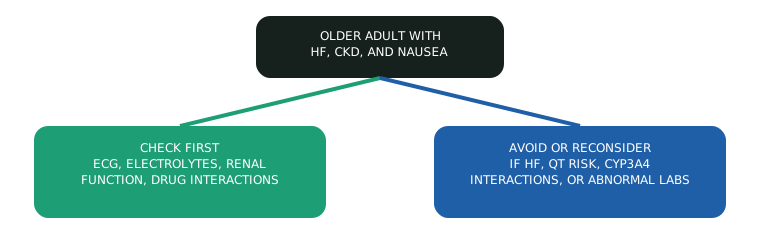
The working diagnosis was acute nausea in a high arrhythmic-risk patient in whom domperidone posed disproportionate potential harm. Before any short-course use, evidence synthesis supports review of a baseline 12-lead electrocardiogram (ECG) when there is HF, structural heart disease, bradycardia, syncope history, CKD with uncertain current biochemistry, or possible interacting drugs. Serum potassium, magnesium, calcium when clinically indicated, and renal function are also relevant because uncorrected biochemical disturbance is part of the proarrhythmic substrate.
| Test or Assessment | Clinical Rationale |
|---|---|
| Medication reconciliation | To identify QT-prolonging medicines and clinically relevant CYP3A4 inhibitors, both of which substantially strengthen the case against domperidone use. |
| 12-lead ECG | To detect baseline QT abnormality, conduction disease, bradycardia, or other arrhythmic substrate before exposing a high-risk patient to a QT-active drug. |
| Potassium, magnesium, calcium, creatinine | To identify correctable electrolyte disturbance or worsening renal function that may amplify torsadogenic risk. |
| Clinical review of nausea etiology | To avoid masking a more important cause such as uremia, drug toxicity, infection, bowel pathology, or congestion-related illness. |
Treatment and Management
In this scenario, the most defensible management decision was not to continue domperidone empirically while the cause of nausea and the patient’s arrhythmic substrate remained unresolved. Evidence synthesis indicates that underlying cardiac disease such as congestive HF should trigger avoidance, and that co-use with QT-prolonging medicines or potent CYP3A4 inhibitors should generally be treated as a high-risk or contraindicated situation. If domperidone is still being considered after review in a lower-risk patient, the supported regimen is 10 mg orally up to three times daily, maximum 30 mg per day, for no longer than 7 days, using the lowest effective dose for nausea and vomiting.
For this patient, management focused on medication reconciliation, biochemical assessment, and identifying a better antiemetic strategy according to indication and local formulary, rather than attempting risk mitigation around a drug that already sat poorly with her baseline profile.
Case Discussion
This case is useful because it shifts attention from abstract drug safety to the real outpatient decision point created by prescription-only access in the Philippines. The strongest available evidence is observational, not randomized, so residual confounding by frailty, indication, and co-medication cannot be eliminated. Even so, the pattern is clinically coherent: older age, higher daily dose, structural heart disease, bradycardia, electrolyte abnormalities, and interacting drugs all cluster in the same direction as the signal for ventricular arrhythmia and sudden cardiac death.
Mechanistically, evidence synthesis attributes concern to QT-related electrophysiologic effects and to exposure amplification when CYP3A4 inhibitors are present. Cardiometabolic disease magnifies this because HF and CKD increase the likelihood of conduction vulnerability, diuretic-associated electrolyte shifts, and polypharmacy. In such patients, normal or undocumented baseline QT status is not enough to reclassify risk as low.
The 2015 nested case-control study also supports caution by identifying risk of out-of-hospital sudden cardiac death among domperidone users in population data. Meanwhile, the two meta-analyses strengthen external consistency, although neither can fully disentangle drug effect from the clinical profile of patients who receive antiemetics. The practical consequence is that medication review becomes more actionable than symptom-based counseling alone. For a patient like the one presented, repeating domperidone without ECG, laboratory review, and interaction screening would bypass the very safeguards that the prescription-only shift is meant to restore.
- CKD:
- chronic kidney disease ;
- CYP3A4:
- cytochrome P450 3A4 ;
- ECG:
- electrocardiogram ;
- HF:
- heart failure ;
- QT:
- corrected QT interval