Clinical Evidence and Local Practice
Will Localized Chronic Coronary Syndrome Guidance Shift CABG Thresholds in the Philippines?
Posted on 3 July 2026 8 mins read
This content is intended for healthcare professionals as clinical decision-support education. It supports, but does not replace, independent clinical judgement.
Localized chronic coronary disease (CCD) guidance in the Philippines could sharpen when coronary artery bypass grafting (CABG) is pursued for prognostic benefit, when guideline-directed medical therapy (GDMT) should be intensified first, and how follow-up should test durable ischemia control rather than procedural completion alone. The key issue is not whether local guidance will replace international recommendations, but whether it will operationalize them around anatomy, diabetes mellitus, left ventricular ejection fraction (LVEF), and surveillance capacity in a resource-variable setting.
Why the Timing of Localization Matters
Public reporting indicates that localized heart guidance has been launched to align treatment in primary care in the Philippines, while the editorial problem in chronic coronary syndromes is that practice now sits between older local pathways and newer international evidence frameworks. In the contemporary guidelines, chronic coronary disease is not an automatic revascularization diagnosis. The 2023 American guidance keeps GDMT as the foundation and reserves revascularization for symptom relief, high-risk anatomy, and selected prognostic groups. The 2024 European guidance similarly positions revascularization within a structured assessment of anatomy, ischemic burden, comorbidity, and operative risk, rather than stable angina alone.
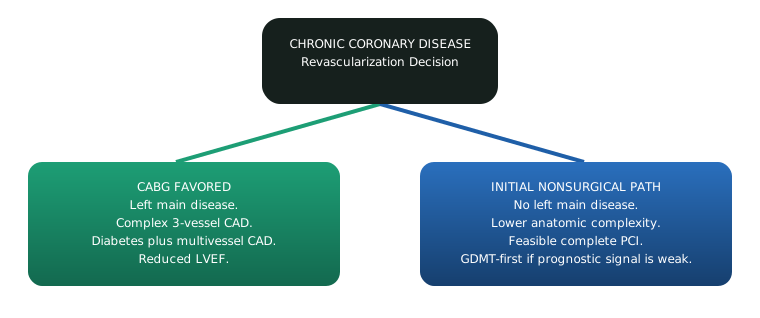
For surgeons and multidisciplinary Heart Team discussions, the question is therefore narrower and more consequential: which chronic coronary disease phenotypes still carry a survival signal for surgery? Across the current literature, evidence synthesis indicates that the most consistent profiles favoring CABG over percutaneous coronary intervention (PCI) or GDMT alone are left main disease, complex three-vessel disease, diabetes mellitus with multivessel coronary artery disease (CAD), and multivessel disease with reduced LVEF, especially when complete and durable PCI is unlikely.
How the Evidence Base Has Narrowed, Not Removed, the CABG Signal
The 2020 ISCHEMIA trial is central because it moved the field away from routine early invasive management for many stable patients with moderate or severe ischemia, showing no reduction in major adverse ischemic events with an initial invasive strategy as compared with an initial conservative strategy in the overall study population. But that result should not be overextended into patients whose anatomy was excluded or underrepresented. ISCHEMIA did not erase the prognostic role of CABG in left main disease or in anatomically high-risk multivessel disease. That narrower interpretation is the one carried forward by both the 2023 AHA/ACC and 2024 ESC documents.
In practice, the main source reconciliation is between a broad stable-ischemia trial and anatomy-centered revascularization guidance. The guidelines treat anatomy, ventricular function, and diabetes as effect modifiers, not as afterthoughts. Evidence synthesis further emphasizes that when disease is diffuse, bifurcation-heavy, calcified, or likely to remain incompletely treated by PCI, surgery regains prognostic plausibility because completeness and durability of revascularization become part of the outcome logic.
Trial Signal
ISCHEMIA
No overall event reduction
Initial invasive strategy versus conservative strategy in the overall stable ischemia population.
Not a CABG-null trial
High-risk anatomic subsets, especially left main disease, were not the population to which a simple GDMT-only conclusion can be generalized.
What Actually Moves the Threshold in Daily Decision-Making
The threshold for CABG is altered less by angina class in isolation than by the interaction among anatomy, myocardial territory at risk, ventricular function, diabetes status, and surgical feasibility. The clearest anatomic triggers are left main disease, especially when accompanied by multivessel involvement, and complex three-vessel CAD where residual disease after PCI is likely. The ESC guideline reinforces CABG as the preferred overall revascularization strategy over PCI for left main CAD in low surgical-risk patients, but still within individualized assessment rather than a purely anatomic reflex.
Clinical modifiers matter because they alter both baseline prognosis and the importance of durable revascularization. Diabetes mellitus with multivessel CAD remains one of the most consistent clinical profiles favoring CABG in the evidence synthesis, while reduced LVEF strengthens the case when substantial jeopardized myocardium is supplied by diseased vessels. The guidelines also sustain the role of a Heart Team approach for these tradeoffs.
| Threshold driver | Why it pushes toward CABG | Evidence base |
|---|---|---|
| Left main disease | Higher prognostic stakes, especially with multivessel or distal complex anatomy | Guideline-based and synthesis-supported |
| Complex three-vessel CAD | Greater risk of incomplete PCI revascularization and repeat procedures | Evidence synthesis indicates persistent CABG advantage as complexity rises |
| Diabetes mellitus | Stronger long-term outcome signal for surgical revascularization in multivessel disease | Evidence synthesis and guideline framing |
| Reduced LVEF | Higher prognostic value of revascularizing extensive viable territory | Guideline framing and synthesis |
Why GDMT Remains Central Before and After Surgery
If localized guidance is to recalibrate practice meaningfully, the most important correction may be against procedural substitution. CABG does not replace secondary prevention; it depends on it. Across the current literature, preoperative optimization before elective CABG should include aspirin continuation in most patients, planned discontinuation of P2Y12 inhibitors before surgery, high-intensity statin therapy, continuation of indicated beta blockers, individualized renin-angiotensin system blockade around the perioperative window, and explicit handling of glucose-lowering therapy, especially sodium-glucose cotransporter-2 (SGLT2) inhibitors.
That perioperative medication logic is clinically important because the surgical risk is not only ischemic. Bleeding, hypotension, atrial fibrillation, acute kidney injury, and euglycemic diabetic ketoacidosis all become relevant when evidence-based chronic therapy is carried into the operating pathway without adjustment. Evidence synthesis indicates that SGLT2 inhibitors should be withheld 3–4 days before surgery because of perioperative ketoacidosis risk, while aspirin is usually continued and P2Y12 agents are usually stopped in advance. This is exactly the type of threshold detail that local guidance can standardize across centers.

Where Localized Guidance Could Have the Greatest Practical Effect
The most actionable local inflection point may be follow-up. Evidence synthesis indicates that routine care after CABG should focus on recurrent angina, new or worsening left ventricular dysfunction, suspicion of graft failure, and sustained secondary prevention adherence rather than routine invasive reassessment in all asymptomatic patients. If symptoms are unstable, prolonged, or occur at rest, the patient should be managed urgently as possible acute coronary syndrome. If recurrent symptoms are stable, the recommended pathway is clinical review, electrocardiography (ECG), transthoracic echocardiography, and targeted ischemia testing or coronary computed tomography angiography when graft failure or native-vessel progression is suspected.
For the Philippines, a localized chronic coronary syndrome framework could therefore matter less by changing the biology of CABG candidacy than by standardizing how centers move from Rural Health Unit or Barangay HC assessment to specialist review, and how a Department of Health (DOH) Hospital or tertiary unit defines symptom triggers, medication continuity, and imaging escalation. The launch of localized heart guidance makes that implementation question timely, even though the source provided here does not specify detailed threshold changes.
- ACE:
- angiotensin-converting enzyme ;
- ARB:
- angiotensin receptor blocker ;
- CABG:
- coronary artery bypass grafting ;
- CAD:
- coronary artery disease ;
- CCD:
- chronic coronary disease ;
- DOH:
- Department of Health ;
- ECG:
- electrocardiography ;
- ESC:
- European Society of Cardiology ;
- GDMT:
- guideline-directed medical therapy ;
- LVEF:
- left ventricular ejection fraction ;
- PCI:
- percutaneous coronary intervention ;
- SGLT2:
- sodium-glucose cotransporter-2