Clinical Evidence and Local Availability
Where Should Inclisiran Sit After Statins and Ezetimibe in ASCVD Care?
Posted on 3 July 2026 7 mins read

This content is intended for healthcare professionals as clinical decision-support education. It supports, but does not replace, independent clinical judgement.
Inclisiran shifts the conversation from whether additional low-density lipoprotein cholesterol (LDL-C) lowering is needed to which nonstatin strategy best fits the patient in front of us. For Philippine practice, the key question is not simply efficacy, but where a twice-yearly small interfering RNA (siRNA) approach belongs relative to ezetimibe, proprotein convertase subtilisin-kexin type 9 (PCSK9) monoclonal antibodies, and persistent adherence gaps in secondary prevention.
Residual LDL-C Risk After Statin-Based Therapy
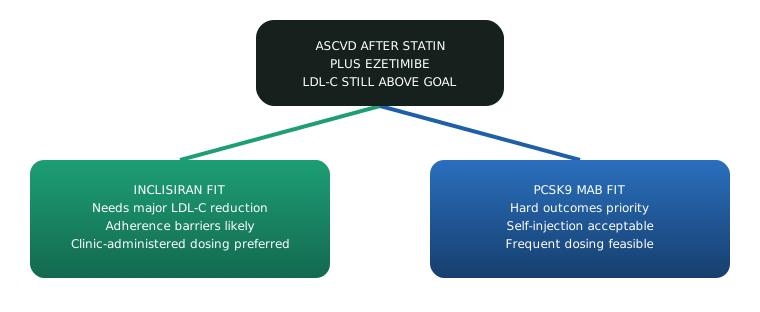
In established atherosclerotic cardiovascular disease (ASCVD), the practical problem is not whether residual lipid risk exists, but how often maximally tolerated statin therapy and ezetimibe still leave a clinically important LDL-C gap. Evidence synthesis across the current literature indicates that inclisiran becomes most relevant when LDL-C remains above target despite statin plus ezetimibe, particularly when additional lowering is needed but long-term implementation is likely to be difficult with daily or frequently injected therapy.
For Philippine specialists, the discussion is no longer hypothetical because inclisiran is locally registered on the Philippine Food and Drug Administration (Philippine FDA) verification portal. That does not, by itself, define sequencing, formulary position, or access within the Philippine National Formulary (PNF), but it does make therapeutic positioning an immediate specialist question rather than a future one.
What the ORION Program Establishes, and What It Does Not
The efficacy case for inclisiran is anchored by ORION-10 and ORION-11. In the phase 3 trials, inclisiran on top of background lipid-lowering therapy produced placebo-corrected LDL-C reductions of about 50% in patients with elevated LDL-C, including established ASCVD and ASCVD-risk populations. The 2024 pooled analysis focused on ASCVD patients from ORION-10 and ORION-11 and reported that LDL-C lowering remained consistent across age, sex, body mass index, kidney function, and glycemic strata, strengthening the argument that residual hypercholesterolemia rather than subgroup identity should drive candidate selection.
ORION-1 matters because it established the pharmacologic logic of infrequent dosing. In that earlier trial, inclisiran demonstrated sustained reductions in both PCSK9 and LDL-C with a schedule that later evolved into the approved day 1, day 90, then every 6 months regimen. For specialists, this is more than a convenience feature. It reframes adherence as a therapeutic design issue rather than simply a patient behavior problem.
ORION-10 and ORION-11 · LDL-C
Phase 3 Signal
49.9–52.2%
Approximate LDL-C reduction
Day 510
Durability landmark in phase 3
The limitation is equally important. The current evidence base is stronger for LDL-C lowering than for definitive hard cardiovascular outcomes. Evidence synthesis indicates that if the dominant clinical question is which agent has the most mature completed outcomes evidence, PCSK9 monoclonal antibodies remain the stronger choice. That distinction should not be blurred. Inclisiran has a credible biologic effect and durable lipid signal, but the hierarchy of evidence still separates lipid efficacy from proven event reduction.
Assessing the outcome
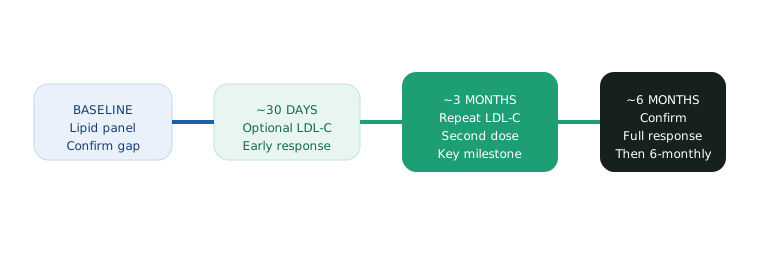
Inclisiran should not be framed as a rescue drug for any LDL-C value above target. Its rational use begins with confirming the baseline LDL-C gap, documenting maximally tolerated statin intensity, verifying prior ezetimibe exposure, and reassessing adherence before escalation. Evidence synthesis indicates that the most defensible monitoring schedule is a lipid panel at baseline, an optional early check from 30 days onward, a formal reassessment at about 3 months when the second dose is due, and a further check around month 6 if confirmation of full early response is clinically useful.
After the loading phase, a response in the range of roughly 45% to 55% LDL-C reduction is consistent with the phase 2 and phase 3 trial signal, while a clearly smaller fall should prompt review of laboratory accuracy, background therapy, secondary causes, and dose timing rather than immediate attribution to drug failure. Absolute LDL-C target remains the more decisive clinical measure in very high-risk ASCVD, because a patient may show an expected pharmacologic response yet still remain above the desired threshold.
Mechanistic Distinction and Practical Implications
Inclisiran is a hepatic small interfering RNA (siRNA) therapy that targets PCSK9 messenger ribonucleic acid, lowering hepatic PCSK9 production and thereby reducing LDL-C. That differs practically from monoclonal antibody PCSK9 inhibition, which neutralizes circulating PCSK9 rather than suppressing its hepatic synthesis. The mechanistic distinction matters clinically because inclisiran’s fixed, infrequent, healthcare-administered schedule can be an implementation advantage in patients whose main obstacle is not biologic resistance but sustained treatment execution.
The approved and locally relevant practical regimen is 284 mg subcutaneously at baseline, again at 3 months, then every 6 months thereafter. Across the current literature, this is why candidate selection should emphasize implementation phenotype: poor adherence history, inability or unwillingness to self-inject more frequently, or a preference for supervised long-interval therapy.
Where Inclisiran Most Defensibly Fits in Specialist Practice
The strongest specialist case is not “any ASCVD patient above target.” It is the patient with persistent LDL-C elevation despite statin plus ezetimibe who still needs substantial additional reduction and is a poor fit for frequent self-administered injectable therapy. That logic extends to heterozygous familial hypercholesterolemia (HeFH), where trial evidence supports about 50% LDL-C lowering on top of background therapy, and to selected high-risk patients with chronic kidney disease (CKD) or diabetes in whom residual hypercholesterolemia persists despite standard care.
| Clinical situation | Why inclisiran may fit | Main caution |
|---|---|---|
| ASCVD above LDL-C goal after statin plus ezetimibe | Durable additional LDL-C lowering of about 50% in ORION trials | Hard outcomes evidence remains less mature than for PCSK9 monoclonal antibodies |
| HeFH with persistent hypercholesterolemia | Clear trial-supported add-on use case with infrequent dosing | Choice versus PCSK9 monoclonal antibody still depends on access and implementation factors |
| CKD or diabetes with residual LDL-C burden | Evidence synthesis indicates use as adjunct therapy when background treatment is insufficient | Continue full risk-factor care, inclisiran is not a substitute for broader prevention |
Safety framing should stay modest and source-faithful. The major labeled contraindication is prior serious hypersensitivity to inclisiran or its excipients, and injection-site reactions are the most common adverse effect described in the prescribing information. In other words, the clinical debate is now less about whether inclisiran works on LDL-C and more about where to place it when evidence hierarchy, patient preference, and adherence architecture point in different directions.
- ASCVD:
- atherosclerotic cardiovascular disease ;
- CKD:
- chronic kidney disease ;
- HeFH:
- heterozygous familial hypercholesterolemia ;
- LDL-C:
- low-density lipoprotein cholesterol ;
- PCSK9:
- proprotein convertase subtilisin-kexin type 9 ;
- PNF:
- Philippine National Formulary ;
- siRNA:
- small interfering RNA