Clinical Evidence and Practice
Should LDL-C Be Intensified Earlier in Hypertensive Filipino Adults? Evidence for Treating Shared Cardiovascular Risk, Not Isolated Numbers
Posted on 3 July 2026 8 mins read
This content is intended for healthcare professionals as clinical decision-support education. It supports, but does not replace, independent clinical judgement.
Hypertension and elevated low-density lipoprotein cholesterol (LDL-C) frequently cluster in the same Filipino adult, yet treatment is still often sequenced rather than risk-integrated. The available evidence supports earlier lipid intensification once blood pressure elevation identifies a patient on a steeper atherosclerotic cardiovascular disease (ASCVD) trajectory, especially when diabetes, chronic kidney disease (CKD), established vascular disease, or severe LDL-C elevation are already present.
Why Hypertension Should Reframe the Lipid Conversation
The 2024 European Society of Cardiology (ESC) guideline on elevated blood pressure and hypertension positions blood pressure as a continuous cardiovascular risk exposure rather than a simple threshold phenomenon, which is clinically important because it argues against a blood pressure first, lipids later mindset in adults who already carry multiple risk determinants. In practice, the hypertensive adult with persistent LDL-C elevation is not just carrying two parallel abnormalities. That patient is moving along a higher absolute risk trajectory in which delayed LDL-C reduction may leave preventable vascular events on the table.
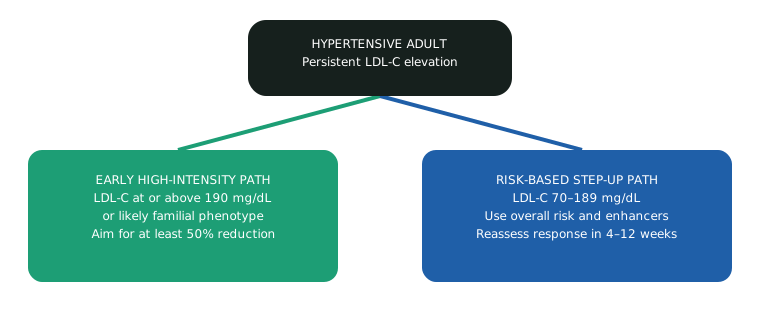
Across the current literature, evidence synthesis indicates that in primary prevention the clearest immediate trigger for high-intensity statin therapy is LDL-C at or above 190 mg/dL, or a phenotype suggesting familial hypercholesterolemia, whereas patients with LDL-C 70–189 mg/dL are usually escalated according to overall risk and risk-enhancing markers rather than LDL-C alone. That distinction matters in hypertensive adults because elevated blood pressure often coexists with CKD, diabetes, metabolic syndrome, family history of premature ASCVD, or other markers that move a patient out of a low urgency category even before overt ASCVD appears.
What the Outcome Trials Actually Support
The strongest trial-level argument for earlier LDL-C lowering is not tied specifically to hypertension, but to the broader principle that cardiovascular benefit tracks with LDL-C reduction across risk states. The Cholesterol Treatment Trialists’ meta-analysis, spanning 170,000 participants in 26 randomized trials, showed that more intensive LDL-C lowering reduced major vascular events by about one-fifth per 1.0 mmol/L LDL-C reduction, including among participants starting from relatively low LDL-C levels. That is a risk-based, not delay-based, message.
Evidence Callout
CTT Meta-analysis
~20%
Lower major vascular events per 1.0 mmol/L LDL-C reduction
26 trials
170,000 participants in randomized evidence base
IMPROVE-IT then extended that logic into combination therapy. After acute coronary syndromes, adding ezetimibe to statin therapy produced incremental event reduction beyond statin monotherapy, supporting the concept that further LDL-C lowering can translate into additional clinical benefit rather than just numerically better lipid panels. In specialist practice, this is the key bridge from statin initiation to statin intensification.
CLEAR Outcomes adds another practical layer for patients who cannot tolerate guideline-recommended statin intensity. In statin-intolerant patients, bempedoic acid reduced total cardiovascular events in a prespecified analysis of the randomized trial, strengthening its place as an oral option when maximally tolerated statin exposure remains insufficient or impossible. The brief cites FOURIER, but no FOURIER source was supplied in the evidence set here, so it cannot be used as a factual basis in this article.
How to Identify the Hypertensive Phenotypes That Warrant Earlier Action
Measurement begins with proper blood pressure characterization. The ESC hypertension guideline emphasizes elevated blood pressure and hypertension assessment within a broader cardiovascular risk framework, which means office findings should not be interpreted in isolation from the patient’s global risk profile. Lipid interpretation should likewise move beyond a single LDL-C value. In a hypertensive adult without prior ASCVD, LDL-C at or above 190 mg/dL remains the most defensible trigger for immediate high-intensity statin therapy. Below that threshold, earlier intensification is justified by aggregate risk: CKD, diabetes, family history of premature ASCVD, metabolic syndrome, persistently elevated triglycerides, inflammatory conditions, or biomarkers such as high-sensitivity C-reactive protein, lipoprotein(a), apolipoprotein B, and abnormal ankle-brachial index.
For patients already on statin therapy, the operational question changes from whether to start to whether response is adequate. Across the current literature, evidence synthesis indicates that LDL-C response and adherence should be reassessed within 4–12 weeks after statin initiation or change in primary prevention, while after adding ezetimibe, a full lipid profile and liver transaminases are commonly rechecked at about 2–3 months.
| Clinical phenotype | Initial lipid strategy | Follow-up focus |
|---|---|---|
| Hypertension with LDL-C at or above 190 mg/dL, or likely familial phenotype | Immediate high-intensity statin | Check LDL-C response and adherence in 4–12 weeks |
| Hypertension with LDL-C 70–189 mg/dL plus risk enhancers | At least moderate-intensity statin, escalate by overall risk | Reassess LDL-C reduction and whether risk was underestimated |
| Above target on maximally tolerated statin, especially with diabetes, CKD, or ASCVD | Add ezetimibe | Lipid profile and liver transaminases at 2–3 months |
| Partial or complete statin intolerance | Rechallenge, lower dose, alternate dosing, then ezetimibe or bempedoic acid as needed | Symptoms, lipid response, liver enzymes, and gout or cholelithiasis risk with bempedoic acid |
Why Elevated Blood Pressure and LDL-C Behave as a Shared Disease Process
The supplied brief frames the combination of blood pressure elevation and LDL-driven atherogenesis as additive through endothelial dysfunction, vascular inflammation, arterial remodeling, and plaque vulnerability. However, those mechanistic details are not explicitly supported in the supplied context sources and therefore cannot be asserted here as source-backed fact. What can be said from the evidence base is narrower but still clinically consequential: the ESC guideline treats blood pressure as a continuous contributor to cardiovascular risk, while LDL-C lowering trials repeatedly show event reduction when lipid burden is driven down more intensively. Together, those findings support integrated risk treatment even when the mechanistic article-level narrative is left conservative.
Medication Strategy for Specialist Practice
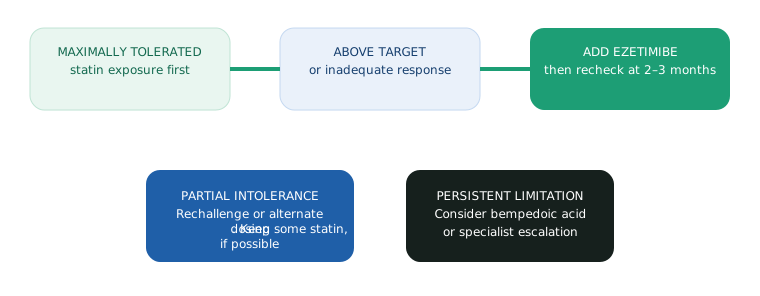
For hypertensive adults without clinical ASCVD, immediate high-intensity statin therapy is best reserved for LDL-C at or above 190 mg/dL or a severe inherited-risk phenotype, with moderate-intensity therapy and reassessment being appropriate for many patients in the 70–189 mg/dL range unless total risk is compelling enough to justify earlier escalation. For patients with diabetes, CKD, or established ASCVD whose LDL-C remains above target despite maximally tolerated statin, ezetimibe is the next supported step.
In statin intolerance, the evidence synthesis consistently argues against premature therapeutic abandonment. Rechallenge, lower-dose therapy, or alternate-day dosing should be attempted when the prior reaction was not severe, because partial statin exposure is often preferable to none. If intolerance persists, ezetimibe is usually first, and bempedoic acid becomes especially relevant as an oral option with outcome data in statin-intolerant patients. One caution is that Reference 7 cites an approximately 21% placebo-adjusted LDL-C reduction with bempedoic acid from a New England Journal of Medicine trial not otherwise supplied as verified metadata here, while the peer-indexed JAMA Cardiology analysis supplied in Reference 4 confirms reduction in total cardiovascular events in CLEAR Outcomes rather than restating that numeric LDL-C effect; the cardiovascular outcome signal is therefore the most defensible lead point from the primary material available in this set, and the exact LDL-C percentage should be confirmed against the primary trial publication before fixing it in a final evidence table.
- ALT:
- alanine aminotransferase ;
- ASCVD:
- atherosclerotic cardiovascular disease ;
- AST:
- aspartate aminotransferase ;
- CK:
- creatine kinase ;
- CKD:
- chronic kidney disease ;
- CTT:
- Cholesterol Treatment Trialists’ ;
- ESC:
- European Society of Cardiology ;
- LDL-C:
- low-density lipoprotein cholesterol